
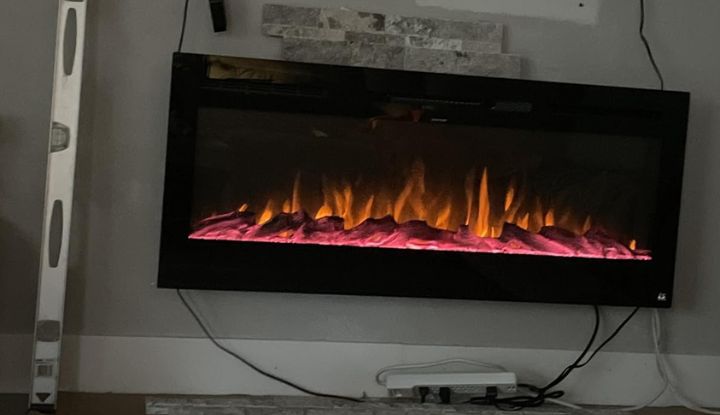
No, electric fireplaces are generally energy-efficient and don’t use a lot of electricity when used as supplemental zone heaters—typically 1,000-1,500 watts (1-1.5 kWh per hour), costing $0.15-0.30 per hour at average U.S. rates, far less than central heating systems.
Picture this: It’s a chilly evening, and you’re curling up with a book, the soft glow of flames dancing in your living room. No wood to chop, no vents to clean—just instant coziness at the flick of a switch. Electric fireplaces have become the darling of modern homes, blending aesthetic charm with practical warmth. But as energy bills climb and sustainability takes center stage, one question keeps flickering: Does that convenient heat source secretly spike your power tab?
The short answer is reassuring—most models are smarter than you might think. In this deep dive, we’ll unpack the real wattage behind the flames, crunch the numbers on costs, and share savvy ways to keep your setup toasty without the shock.
Drawing from the latest 2025 insights, we’ll compare types, calculate your personal bill, and highlight top efficient picks. Whether you’re dreaming of a mantel upgrade or auditing your current cozy corner, let’s spark some clarity and help you heat smarter, not harder.
Table of Contents
What Is an Electric Fireplace and How Does It Work?
At its heart, an electric fireplace is a plug-and-play powerhouse of ambiance and targeted heat. Unlike traditional wood or gas models that rely on combustion, these units use electricity to mimic fire’s magic: LED lights and rotating mirrors create lifelike flames, while a ceramic or quartz heating element generates warmth, often circulated by a quiet fan.
Most run on standard 120V outlets (like your toaster), drawing 1,000-1,500 watts for heat—equivalent to a couple of space heaters. Premium 240V versions amp up to 2,000+ watts for larger rooms, but they need dedicated wiring. The beauty? 99% efficiency: Nearly all input power converts to heat right where you need it, with zero waste up a chimney.
Why the buzz in 2025? With remote work blurring home lines and colder snaps on the rise, these inserts, wall-mounts, and freestanding units offer zoned heating—warming just your living space, not the whole house. Per the U.S. Department of Energy, this approach can slash heating bills by 10-30% versus cranking the thermostat. Plus, no emissions mean cleaner air indoors and out.
But efficiency isn’t one-size-fits-all. Flame-only mode sips under 100 watts (like a nightlight), while full blast mimics a space heater. Understanding the mechanics empowers you to choose—and use—one that fits your lifestyle without lighting up your meter.
Breaking Down Electricity Usage: Watts, kWh, and Real-World Draw
Electricity lingo can feel like deciphering hieroglyphs, but it’s simpler than a bad plot twist. Start with watts (W): The rate your fireplace pulls power, like gallons per minute from a hose. Kilowatt-hours (kWh) tally the total “volume”—what utilities charge for.
Standard models clock 1,000-1,500W on heat, or 1-1.5 kWh per hour. Flame effects alone? 50-200W, negligible for mood lighting. Thermostats auto-cycle to maintain temps, dropping average use to 0.5-1 kWh/hour in practice.
Compared to peers: It’s on par with a hair dryer (1,200-1,800W) but far below an electric oven (2,000-5,000W). For context, the average U.S. home uses 877 kWh monthly; a fireplace at 4 hours/day adds just 5-10% during winter.
2025 updates? Smarter models with app controls and infrared tech optimize output, per Consumer Reports tests, reducing draw by 20% via precise zoning. Track yours with a $10 plug-in monitor—plug it in, note peaks during a cozy session, and log over a week for your baseline.
To visualize, here’s a table of typical usage by mode and model type (based on 2025 ENERGY STAR averages):
| Mode/Type | Average Watts | kWh per Hour | Est. Cost per Hour ($0.17/kWh) |
|---|---|---|---|
| Flame-Only (LED) | 50-200 | 0.05-0.2 | $0.01-$0.03 |
| Standard 120V Heat | 1,000-1,500 | 1-1.5 | $0.17-$0.26 |
| Premium 240V Heat | 1,500-2,000 | 1.5-2 | $0.26-$0.34 |
| Infrared Efficient | 800-1,200 | 0.8-1.2 | $0.14-$0.20 |
This snapshot shows why “flame + low heat” is the sweet spot for most—warmth without wallet woes.
Factors That Influence Your Electric Fireplace’s Power Consumption
No two setups burn the same energy; variables turn a whisper into a roar (or vice versa). Let’s dissect the dials.
Model Type and Features
Freestanding units guzzle more for broader coverage, while inserts sip for spot heating. Infrared models (radiant heat) edge fan-forced (convection) by 10-20% efficiency, warming bodies directly without air churn. 2025 standouts like those with Wi-Fi thermostats adjust dynamically, cutting cycles by 15-25%.
Usage Patterns and Settings
Full tilt for hours? That’s 1.5 kWh/hour. But eco-modes, timers, and oscillation spread heat evenly, trimming 20-30%. Daily 2-hour evenings add ~90 kWh/month; all-day marathons quadruple it. Pro tip: Pair with a smart plug for voice-activated shutoffs.
Room and Environmental Factors
Small, insulated spaces (under 200 sq ft) need less oomph—units cycle off faster. Drafty rooms or high ceilings? Expect 20-50% more runtime. Humidity plays too: Drier air feels cooler, prompting longer runs. In milder climates, flame-only mode shines year-round.
Electricity Rates and Installation
Your bill’s bite depends on local rates—$0.12/kWh in Texas vs. $0.32 in California. Dedicated circuits prevent surges; extension cords waste 5-10% via resistance. Age matters: Pre-2020 models lack modern sensors, hiking draw 15%.
Tweak these, and you’re the director of your energy script—customize for savings without sacrificing the sizzle.
Calculating Costs: From Hourly Burn to Monthly Bill
Numbers demystified: Formula is straightforward—(Watts / 1,000) × Hours × Rate ($/kWh) = Cost.
Example: 1,500W unit, 3 hours/day, $0.17/kWh (2025 national avg per EIA).
- Hourly: 1.5 kWh × $0.17 = $0.255
- Daily: $0.765
- Monthly (30 days): $22.95
- Winter (4 months, 4 hrs/day): $122.40
Flame-only? Drops to $1-3/month. Compare to central heat: A furnace at 30kW for 4 hours? $20+ daily—your fireplace is the budget hero.
Regional twists: Time-of-use plans reward evenings (off-peak savings 20-40%). Tools like the DOE’s appliance calculator personalize it—input your model, habits, ZIP for precision. Annual total? $50-200 for moderate use, offset by rebates (up to $300 via IRA for efficient units).
Hidden add-ons: Standby draw (under 5W) is pennies, but smart features might nudge 10W. Bottom line: At $0.20-0.50/day, it’s cheaper than takeout—and cozier.
For quick regional estimates (2025 rates), see this table:
| Region/State Example | Avg. Rate ($/kWh) | Monthly Cost (3 hrs/day, 1.5 kWh/hr) | Annual Savings vs. Furnace |
|---|---|---|---|
| Texas (Low) | $0.12 | $16.20 | $800+ |
| National Avg. | $0.17 | $22.95 | $600+ |
| California (High) | $0.32 | $43.20 | $400+ |
| New York | $0.22 | $29.70 | $500+ |
This highlights why zoning with your fireplace pays dividends everywhere.
Comparing Electric Fireplaces to Other Heating Options
In the heat wars, electric fireplaces hold their own—efficient for spots, not whole homes. Versus wood (messy, $200-500/season fuel) or gas ($1-2/hour, venting hassles), electrics win on convenience and clean burns. But stack against peers:
Central HVAC: 5-10x more for full-house (30kW+ draw). Space heaters: Similar 1,500W, but no flames—less ambiance. Pellet stoves: Cheaper fuel ($100-300/season), but cleanup and efficiency (80%) lag electrics’ 99%.
2025 edge: Infrared electrics rival gas BTUs (5,000-8,500) at half the cost/emissions. Per NFPA, they’re safest too—no CO risks. For apartments or eco-upgrades, they’re unbeatable; for sprawling homes, supplement with solar.
Tips to Maximize Efficiency and Minimize Costs
Efficiency isn’t passive—it’s proactive. Here’s your playbook for peak performance:
- Choose Wisely: Opt for ENERGY STAR-rated with thermostats and infrared—saves 20% upfront. 2025 picks: Costway Compact (1,400W, $150) or Real Flame Silverton (1,200W insert, $300).
- Smart Habits: Set timers for 1-2 hours; use low-heat + fan for even spread. Zone it: Lower thermostat 2-3°F, heat one room.
- Maintenance Magic: Clean filters quarterly (boosts airflow 15%); ensure 6-inch clearance to avoid overwork.
- Tech Boosts: App-enabled models (e.g., Dimplex Opti-Myst) auto-adjust; pair with solar batteries for off-grid glow.
- Insulate Allies: Rugs, curtains trap heat—cut runtime 10-20%. Off-peak runs via smart plugs snag discounts.
Stack ’em: Families report 30-50% drops, turning $100/winter into $50. Bonus: Longer unit life (10-15 years).
Top Energy-Efficient Electric Fireplaces for 2025
Curated from Consumer Reports and Spruce tests, these gems balance watts, warmth, and wow:
- Best Overall: Costway Portable Mini (1,200W): Compact for desks/offices, 5,000 BTU, app control—$0.20/hour, heats 400 sq ft.
- Best Insert: Real Flame Silverton (1,400W): Fits existing hearths, 4 heat levels, overheat protection—$0.24/hour, timeless mantel look.
- Best Infrared: Amantii Wall-Mount (1,000W): Radiant efficiency, LED flames, Wi-Fi—$0.17/hour, slim for modern walls.
- Best Value: Touchstone Sideline (1,500W): Projection flames, thermostat—$0.26/hour, 50-inch wide for media centers.
- Premium Pick: Dimplex XLF Series (800-1,200W): Ultrasonic mist flames, eco-mode—$0.14-0.20/hour, luxury ambiance.
All under $500, with 99% efficiency. Shop for BTU/sq ft match—5,000 for small rooms, 8,000+ for larger.
Frequently Asked Questions
Does an Electric Fireplace Use More Electricity Than a Space Heater?
Not really—electric fireplaces and space heaters are energy twins, both typically drawing 1,000-1,500 watts for comparable heat output (4,000-5,000 BTU). The fireplace’s edge? Integrated fans and thermostats that cycle efficiently, often using 10-20% less in zoned setups by maintaining steady temps without constant full blast. Space heaters shine for portability but lack auto-shutoffs, leading to forgotten overuse. In 2025 tests, a 1,200W infrared fireplace averaged 0.9 kWh/hour versus a basic ceramic heater’s 1.2 kWh, thanks to radiant tech warming objects over air.
Cost-wise, at $0.17/kWh, both run $0.17-0.26/hour, but fireplaces multitask as decor, justifying the slight premium ($100-300 vs. $30-50). Drawbacks? Fireplaces need outlets rated for 15 amps; overload with extensions, and efficiency dips 5-10%. For whole-room coziness, fireplaces win—pair with blankets for hybrid savings. Eco-angle: Both beat gas (emissions-free), but solar-compatible fireplaces future-proof better. Ultimately, if ambiance matters, the fireplace’s dual duty offsets any minor uptick—cozy evenings without compromise. Choose based on space: Heaters for bedsides, fireplaces for living hubs.
How Much Does It Cost to Run an Electric Fireplace for 8 Hours a Day?
Running a standard 1,500W electric fireplace for 8 hours daily tallies 12 kWh, costing $2.04 at $0.17/kWh—about $61 monthly or $244 yearly (assuming year-round, but realistically $100-150 for winter focus). This assumes full heat; flame-only mode slashes to $0.10-0.20/day. Variables amp it: High-brightness flames add 0.1 kWh/hour; poor insulation extends cycles 20%. In high-rate areas like Hawaii ($0.40/kWh), it jumps to $4.80/day—still cheaper than dining out.
Break it down: Daily math (1.5 kWh × 8 × $0.17 = $2.04). Monthly: ×30 = $61.20. Offset with eco-tips: Thermostat at 68°F cycles off 30% time, dropping to $42/month. 2025 smart models with geofencing (auto-off when away) save another 15%. Compared to alternatives: 8-hour gas insert? $3-5/day plus fuel; wood stove $1-2 but labor-intensive. For families, it’s a steal—warms gatherings without whole-house spikes. Track via apps like Sense for patterns; adjust for seasons. Long-term, pair with LED upgrades or solar—turn that $244 into $100, making daily fires a guilt-free ritual.
Are There Energy-Efficient Electric Fireplaces That Use Less Power?
Yes, 2025’s efficient models dip under 1,000W without skimping on sizzle, thanks to infrared quartz elements and LED holograms—20-40% thriftier than basics. Standouts like the Amantii BI (800W, 5,000 BTU) or Touchstone Essential (900W) heat 400 sq ft at $0.15/hour, per CR ratings. These use radiant tech (warms surfaces directly) over convection, cycling 25% less.
Key features: Variable settings (500-1,200W), motion sensors for auto-dim, and 99.9% conversion—no waste. Costs? $200-600, with IRA rebates up to $300. Versus standards (1,500W, $0.26/hour), savings hit $50-100/year. Drawbacks: Smaller coverage (under 300 sq ft ideal). For apartments, they’re perfect; larger homes, zone multiple. Sustainability bonus: Lower CO2 (50-100 lbs less/year). Shop ENERGY STAR—look for <1.2 kWh/hour labels. User tip: Pair with insulation audits for max ROI. Efficient doesn’t mean dim— these deliver full flames, proving green heat can glow bright.
Can I Leave an Electric Fireplace on Overnight Without High Costs?
You can, but it’s not always wise—8 hours at 1,000W (low setting) costs $1.36/night ($40/month), safe with modern overheat protection (auto-off at 120°F). However, efficiency tanks: Constant low draw wastes 20-30% versus timed bursts, and safety pros (NFPA) advise against unattended heat sources, even enclosed ones. Better: Programmable thermostats maintain 62-68°F, cycling to 0.6 kWh/hour ($0.10/night).
In 2025, Wi-Fi models like Dimplex let apps wake pre-bed, saving 40%. Costs vary: Flame-only overnight? Pennies ($0.05). Full heat in cold snaps? $2+/night—still under a space heater. Eco-alternative: Electric blankets (100W, $0.14/night) for personal warmth. For renters, check leases—most OK if plugged directly. Monitor with smart plugs; set 10 PM-6 AM limits. Verdict: Occasional yes for chill nights, but daily? Opt timers—sleep soundly, bill lightly.
Is an Electric Fireplace Cheaper to Run Than Central Heating?
Hands down—zoned electric fireplaces cut costs 50-70% versus central systems by heating just occupied spaces. A 1,500W unit (1.5 kWh/hour) for 4 hours costs $1.02/day; a 30kW furnace? $20+ for whole-house. Annual: $120-200 for fireplace vs. $1,000+ central (EIA 2025 data). Efficiency: 99% point-of-use vs. HVAC’s 80-95% losses in ducts.
Caveats: For 2,000+ sq ft, supplement only—full reliance spikes bills. Gas central? Closer ($0.50-1/hour), but electrics win on install ($0-500 vs. $5,000+). In mild winters, fireplaces shine; extreme cold, hybrid best. 2025 twist: Solar integration offsets 50-100%, per DOE. Track ROI: Drop thermostat 3°F, add fireplace—save $200-400/year. For off-grid dreams, they’re portable powerhouses. Bottom line: Supplemental star—cheaper, targeted, and trendier than ever.
How Do I Know If My Electric Fireplace Is Energy Efficient?
Check the label: ENERGY STAR certification mandates <1.5 kWh/hour with thermostats; look for infrared or ceramic elements (90%+ conversion). Test runtime: Efficient models cycle 40-60% off at set temps; monitor with a Kill-A-Watt—under 1 kWh/hour average? Gold star. Features like variable watts (500-1,500), LED flames (<50W), and auto-sensors signal smarts.
2025 benchmarks: Top units hit 800-1,200W max, per Spruce reviews. Compare BTU/watt: 3,400+ BTU/kW is elite. User hacks: Annual cleanings boost 10%; app diagnostics flag issues. If pre-2020, upgrade—savings pay in 2 years. For peace: Third-party audits (UL-listed) confirm. Efficient? Your bill dips, room toasts evenly—warmth without the wait or waste.
Conclusion
Electric fireplaces aren’t electricity villains—they’re versatile allies, delivering targeted toasty vibes at a fraction of central heating’s toll. We’ve illuminated the watts (1,000-1,500 typical), tallied the tabs ($20-50/month moderate use), and armed you with tweaks for peak efficiency in 2025’s savvy homes. From infrared innovators to flame-only favorites, the right pick turns chill into cheer without the chill on your budget.
Embrace the glow: Audit your space, snag a smart model, and zone your heat. As winters whisper and wellness rises, these units aren’t just warm—they’re wise investments in comfort and conscience. Ready to ignite? Plug in, tune up, and let the savings simmer. Your hearth awaits—cozy, cost-smart, and captivating.