
Yes, power surges can absolutely cause electrical problems — ranging from minor glitches and reduced appliance lifespan to immediate burnout of sensitive electronics, tripped breakers, melted wiring, and even house fires.
You’re watching TV when suddenly every light in the house flickers, your computer reboots, and the microwave starts making a strange humming noise. That brief “blink” wasn’t harmless — it was likely a power surge, and it just sent thousands of extra volts racing through your home’s wiring. Most of the time you get lucky and nothing obvious breaks, but behind the walls and inside your devices, damage is quietly adding up.
Power surges are one of the most misunderstood and underestimated threats to home and business electrical systems. In this guide, we’ll explain exactly how surges happen, what they do to your wiring and appliances, the warning signs you should never ignore, and — most importantly — how to protect yourself before the next surge strikes. Let’s clear up the myths and give you the facts you need to keep your home safe.
Table of Contents
What Exactly Is a Power Surge?
A power surge is a sudden, brief spike in voltage that lasts from a few microseconds to a fraction of a second. Normal household voltage in the U.S. is 120 V (or 240 V for large appliances). During a surge, that can jump to hundreds or even thousands of volts.
There are two main categories:
- External surges — caused by lightning strikes, utility grid switching, downed power lines, or transformer issues.
- Internal surges — created inside your own home when large motors (air conditioners, refrigerators, elevators, well pumps) turn off and release stored energy back into the wiring.
Even though external surges get all the drama (lightning can deliver 100 million volts!), roughly 80 % of surges actually originate inside the home and are far more frequent.
How Power Surges Damage Electrical Systems and Devices
When excess voltage hits, electricity looks for the path of least resistance. Unfortunately, that path often runs straight through the delicate semiconductors, circuit boards, and insulation in your electronics and wiring. Here’s what actually happens:
- Immediate catastrophic failure → LEDs blow, power supplies fry, circuit boards develop burnt spots.
- Cumulative “wear-and-tear” damage → Each small surge degrades insulation, chips away at transistor junctions, and weakens solder joints. Devices mysteriously fail months or years earlier than expected.
- Overheating of wiring → High voltage can melt insulation or create arcing, leading to dangerous hot spots inside walls.
- Tripped breakers or blown fuses → A protective reaction, but repeated tripping weakens the breaker over time.
- Data corruption → Computers, DVRs, and smart TVs lose files or develop bad sectors.
The scary part? Most surge damage is invisible until the device finally gives up.
Here’s a quick-look table of common household items and their vulnerability:
| Device / System | Surge Sensitivity | Typical Lifespan Reduction | Average Repair/Replacement Cost |
|---|---|---|---|
| LED/LCD TVs | Very High | 3–7 years lost | $300 – $2,000 |
| Computers & Laptops | Very High | 2–5 years lost | |
| HVAC Systems & Motors | High | 5–10 years lost | $4,000 – $12,000 |
| Refrigerators & Freezers | Moderate–High | 3–8 years lost | $800 – $2,500 |
| Microwave Ovens | High | Often immediate failure | $150 – $600 |
| Home Wiring & Outlets | Moderate | Progressive insulation damage | $2,000 – $15,000+ (rewiring) |
Common Signs Your Home Has Experienced Damaging Power Surges
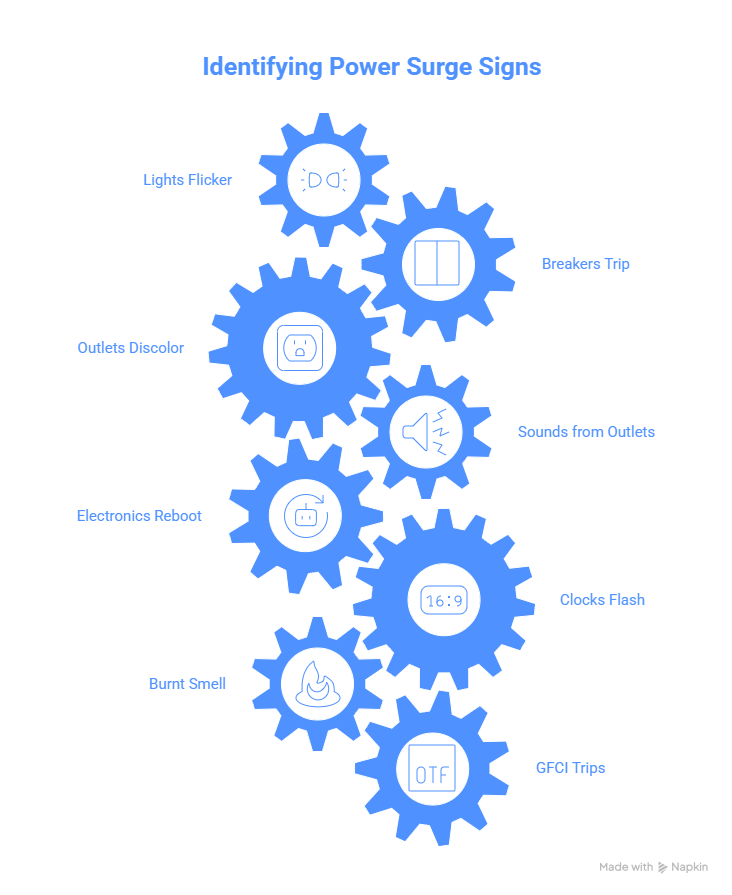
Many people only realize they’ve had surges after expensive equipment dies. Watch for these red flags:
- Lights suddenly brighten then dim (classic “flicker”)
- Frequent breaker trips for no obvious reason
- Warm or discolored outlets and switches
- Buzzing or crackling sounds from outlets
- Electronics that reboot themselves
- Clock displays on ovens, microwaves, or coffee makers constantly flashing 12:00
- Burnt plastic smell near appliances or the electrical panel
- GFCI outlets that trip repeatedly
If you notice two or more of these, schedule an electrician visit — hidden damage could already be present.
Most Common Causes of Power Surges in Homes
Understanding the source or Causes of Power Surges helps you prevent or mitigate future events:
- Lightning strikes — Even miles away, lightning induces massive surges through power lines.
- Utility grid switching — Power company maintenance or faults cause momentary spikes.
- Downed or damaged power lines — Trees, car accidents, storms.
- Large appliances cycling — Central A/C, well pumps, elevators, garage door openers.
- Faulty or old wiring — Loose connections create arcing and mini-surges.
- Neighbor-shared transformers — When your neighbor’s heavy equipment turns off, you feel it.
Long-Term Consequences If Surges Are Ignored
A single major surge can cost thousands in repairs, but repeated small surges are actually more dangerous over time because:
- Insulation on wires breaks down → increased fire risk
- Circuit breakers weaken and fail to trip during real overloads
- Electronics suffer “digital fatigue” and fail prematurely
- Homeowners insurance may deny claims if lack of surge protection is proven
The National Fire Protection Association reports that electrical malfunctions are involved in roughly 45,000 home fires annually in the U.S. — many traceable to surge-related arc faults.
Learn More : How Long Does It Take to Become an Electrical Engineer?
How to Protect Your Home and Electronics from Power Surges
Protection works in layers — the more layers, the safer you are.
| Protection Level | What It Protects | Approximate Cost |
|---|---|---|
| Point-of-use strip | Single device or entertainment center | $15 – $80 |
| Whole-house Type-3 | Installed at panel (basic) | $200 – $500 installed |
| Whole-house Type-2 | Stronger panel protection | $400 – $900 installed |
| Whole-house Type-1 | Highest rating — protects against lightning | $800 – $2,500 installed |
Best practice: Combine a Type-1 or Type-2 whole-house suppressor with point-of-use strips on expensive electronics.
Additional tips:
- Unplug sensitive items during thunderstorms
- Replace surge strips older than 3–5 years (they wear out!)
- Have an electrician inspect wiring if your home is >25 years old
- Install arc-fault circuit interrupters (AFCIs) — they detect surge-related arcing
Frequently Asked Questions
Can a Power Surge Damage Appliances Even When They’re Turned Off?
Yes — absolutely. As long as an appliance is plugged in, electricity is still flowing through its power supply and circuitry. A surge can easily jump the off switch and fry capacitors, transformers, and microchips even when the device appears dormant. This is why TVs, gaming consoles, and desktop computers often die during storms even when nobody was using them. The only 100 % safe option during severe weather is to unplug or use a surge protector with a high joule rating and “protected when lit” indicator. Whole-house protection is even better because it stops the surge before it ever reaches the outlet.
How Long Do Surge Protectors Last and When Should You Replace Them?
Most quality surge protectors last 3–5 years under normal conditions, but they sacrifice themselves to protect your gear. After absorbing one or more significant surges, the internal MOVs (metal oxide varistors) degrade and eventually fail open — meaning they stop protecting but still pass power. Warning signs include: the “protected” light goes out, burnt plastic smell, or visible scorch marks. Many premium models now include auto-shutoff when protection is lost. Mark the installation date with a Sharpie and replace every 4 years or immediately after a known major surge event (lightning, utility fault, etc.).
Can Power Surges Cause a House Fire?
Yes, and they do more often than most people realize. When a surge exceeds the insulation rating of wiring or creates arcing inside walls, temperatures can spike to thousands of degrees in milliseconds. Loose connections made worse by repeated surges are a leading cause of electrical fires. The U.S. Fire Administration notes that surge-related arc faults are especially dangerous because they can smolder undetected for hours or days before igniting surrounding materials. Modern arc-fault breakers (AFCIs) and whole-house surge protection dramatically reduce this risk.
Do UPS Battery Backups Protect Against Power Surges?
A common misconception! Most consumer-grade UPS units provide only minimal surge protection — often less than a $30 power strip. Their primary job is to supply temporary battery power during blackouts, not to absorb large surges. Only UPS models that specifically advertise “AVR” (automatic voltage regulation) and high joule ratings (2,000+ joules) offer meaningful surge defense. For true protection, pair a good UPS with whole-house surge suppression.
Will Homeowners Insurance Cover Surge Damage?
Standard policies usually cover lightning surges, but many exclude or severely limit coverage for surges caused by internal appliances or utility fluctuations. Typical limits range from $1,000–$5,000 for electronics, far below replacement cost for a whole entertainment system or HVAC unit. Some insurers require proof of surge protection to pay claims. Adding a specific “equipment breakdown” or “power surge” rider is inexpensive ($30–$80/year) and often pays for itself after just one incident.
Is Lightning the Most Common Cause of Damaging Power Surges?
No — lightning causes the most dramatic and expensive surges, but it accounts for only about 20 % of incidents. The remaining 80 % come from everyday internal sources: air conditioners, refrigerators, washers, dryers, well pumps, and even vacuum cleaners cycling on and off. These smaller (300–3,000 volt) surges happen multiple times per day in the average home and cause far more cumulative damage over time than the rare lightning strike. This is why whole-house surge protection is recommended even in low-lightning areas.
Conclusion
Power surges are silent, frequent, and far more destructive than most homeowners realize. A single event can instantly destroy thousands of dollars in electronics, while years of small surges quietly shorten the life of everything plugged into your walls — including the wiring itself.
The good news? Protection is straightforward and relatively inexpensive compared to the cost of replacement and repairs. Installing a quality whole-house surge protector (ideally Type-1 or Type-2) combined with point-of-use strips on expensive electronics gives you near-bulletproof defense.
Don’t wait for the next flicker or thunderstorm to act. Have a licensed electrician assess your panel and wiring age, then invest in layered surge protection today. A few hundred dollars now can save you tens of thousands — and potentially your home — tomorrow.
Stay safe, stay protected, and keep the power flowing exactly where you want it.